 |
Welcome to Ñîght§håÐë's World |
 |
Interested in all that is NightShade?? You have come to the right place.
Nightshade or
Solanaceae, is a family of flowering plants that are actually very toxic, though
some do have edible parts. You may have seen some of the edible parts in
you daily living, such as the tomato and the potato. The Solanaceae are
known for possessing a diverse range of alkaloidal glucosides, or simply
alkaloids. As far as humans are concerned, these alkaloids can be desirable,
toxic, or both, though they presumably evolved because they reduced the tendency
of animals to eat the plants.
One of the most
important groups of these compounds is called the tropane alkaloids. The term "tropane"
comes from a genus in which they are found, Atropa (the belladonna genus). The
belladonna genus is so named after the Greek Fate, Atropos, who cut the thread
of life. This nomenclature betrays the toxicity and lethality that has long been
known to be characteristic of these compounds. Tropane alkaloids are also found
in the Datura, Mandragora, and Brugmansia genera, as well as many others in the
Solanaceae family. Chemically, the molecules of these compounds have a
characteristic bicyclic structure and include atropine, scopolamine, and
hyoscyamine. Pharmacologically, they are the most powerful known
anticholinergics in existence, meaning they inhibit the neurological signals
transmitted by the endogenous neurotransmitter, acetylcholine. Symptoms of
overdose may include mouth dryness, dilated pupils, ataxia, urinary retention,
hallucinations, convulsions, coma, and death. Despite the extreme toxicity of
the tropanes, they are important drugs when administered in appropriate (and
extremely small) dosages. They can reverse cholinergic poisoning, which can be
caused by overexposure to pesticides and chemical warfare agents such as sarin
and VX. More commonly, they can halt many types of allergic reactions.
The most famous
alkaloid from the Solanaceae family is nicotine. Like the tropanes, its
pharmacology acts on cholinergic neurons, but with the opposite effect (it is an
agonist as opposed to an antagonist). It has a higher specificity for nicotinic
acetylcholine receptors than other ACh proteins. Its effects are well known.
Nicotine occurs naturally in the Nicotiana or Tobacco genus. Nicotiana tabacum,
the tobacco plant is well known for causing cancer.
Capsaicin is structurally unrelated to nicotine or the tropanes, and is found in
the genus Capsicum, which includes chile peppers such as Tabasco peppers and
habaneros. The compound is not appreciably toxic to animals. However, it
stimulates specific pain receptors in most mammals, those which sense heat, in
the oral mucosa as well as many other epithelial tissues. This causes a
sensation of burning not unlike an actual heat or chemical burn. It is used in
high concentration as a deterrent in pepper sprays, and sought after for many
culinary dishes for its "spiciness". It is thought that the reason one would
deliberately induce pain while eating is the rewarding release of endorphins it
has been shown to induce. The "hotness" of capsaicin products and foods is
expressed in Scoville units. A scoville unit is the factor by which the
capsaicin-containing substance must be diluted to render the resulting solution
imperceptible to a tester (for example, a teaspoon of a 5,000 Scoville unit hot
sauce would have to be diluted with 4,999 teaspoons of a sugar water solution to
negate its potential to cause a sensation on the palate).
|
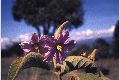
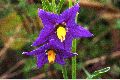
Solanum anguivi
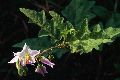
Solanum carolinense
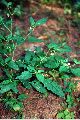
Solanum americanum |
Acnistus Atropa (deadly nightshade) Browallia Brugmansia (angel's trumpet) Brunfelsia Calibrachoa Capsicum (chile peppers) Cestrum Chamaesaracha Combera Crenidium Cuatresia Cyphanthera Cyphomandra Datura (jimsonweed) Hyoscyamus (henbane) Iochroma Juanulloa Lycium (boxthorn) Mandragora (mandrake) Nicandra Nicotiana (tobacco) Nierembergia or cupflower Nolana Petunia Physalis (tomatillo) Scopolia Solandra Solanum (tomato, potato, eggplant) Streptosolen Withania |
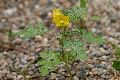
Solanum rostratum
Solanum umbelliferum
Solanum xanti |